

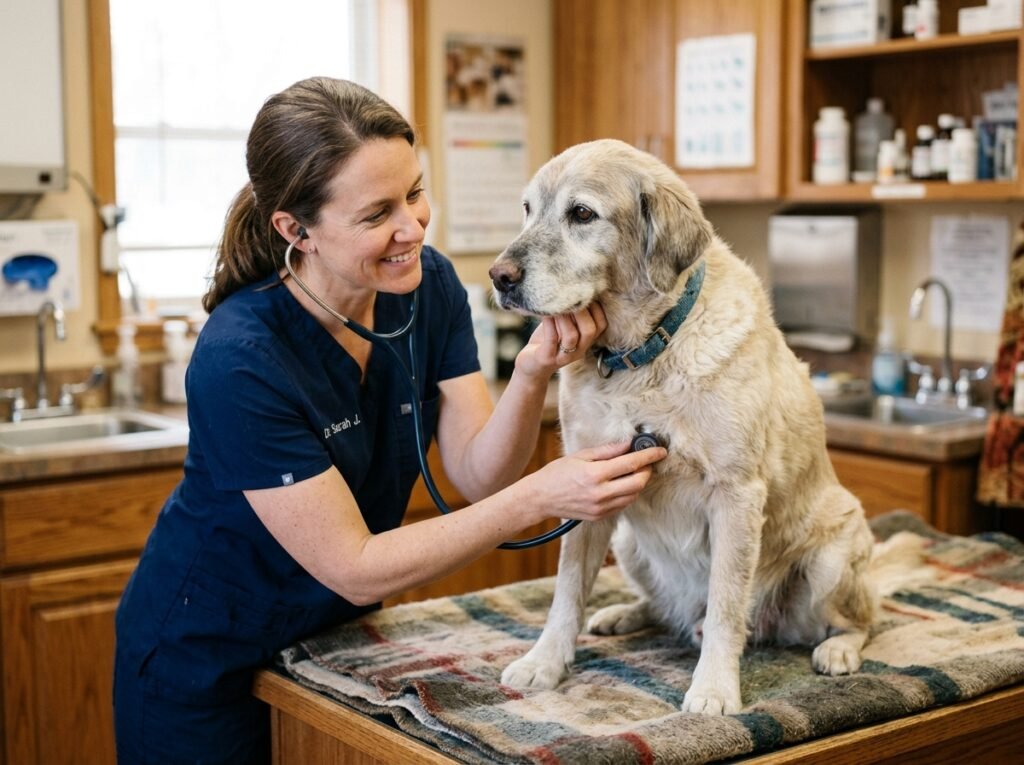
Hearing your veterinarian gently pause with a stethoscope and announce that your older companion has a dog heart murmur is a moment that instantly stops any owner in their tracks. You look down at your sweet senior dog, who seems completely normal and happy on the exam table, and you suddenly wonder how long their heart has been struggling in silence.
You wonder what the numbers and grades mean when your vet describes a Grade 2 or Grade 4 heart murmur and you worry whether this diagnosis means your dog is in immediate danger of heart failure, whether they can still enjoy their daily walks, or how long they have left to share with you.
Your concern is completely natural. A heart murmur diagnosis in an aging pet can feel frightening. However, a heart murmur is not a sudden medical catastrophe on its own. In fact, many older dogs live comfortable, energetic, and happy lives for years after a murmur is first detected. With modern veterinary staging, early medication like pimobendan, and simple home breathing checks, you can protect your dog’s heart function and enjoy wonderful golden years together.
Quick Answer:
A dog heart murmur is an abnormal, turbulent swooshing sound heard between heartbeats, most commonly caused by age-related Myxomatous Mitral Valve Disease (MMVD) where the heart valve leaks backward. Murmurs are graded from 1 (very soft) to 6 (loud with a palpable chest vibration). While mild murmurs (Grades 1–3) require monitoring, dogs with enlarged hearts (ACVIM Stage B2) benefit significantly from early medications to delay heart failure by over a year.
Key Takeaways:
- The 6 Murmur Grades: Graded strictly by loudness (Grade 1 is barely audible; Grade 6 is loud and audible with the stethoscope barely touching the chest).
- ACVIM Staging Protocol: Stage B1 has no heart enlargement, while Stage B2 shows heart enlargement on X-rays or echocardiograms and requires proactive medical therapy.
- Most Critical Home Tracker: Sleeping Respiratory Rate (SRR). Counting breaths per minute while your dog is in deep sleep (normal is under 30 breaths per minute).
- Emergency Red Flags: Resting breathing rate consistently over 35–40 breaths per minute, sudden coughing spells with white foam, blue/grey gums, or sudden collapse.
This guide explains what a heart murmur is, the six clinical murmur grades, ACVIM staging, how to track sleeping respiratory rates, and practical daily home care tips.
What Is a Dog Heart Murmur?
Inside a healthy canine heart, four muscular chambers and delicate fibrous valves work in harmony. Blood flows smoothly in one direction through the valves, producing the classic crisp “lub-dub” sound when the valves snap shut.
A heart murmur occurs when blood flow becomes turbulent. Instead of a clean snap, the stethoscope picks up a soft, whooshing or swishing sound. In senior dogs, this turbulence is overwhelmingly caused by Myxomatous Mitral Valve Disease (MMVD), also known as degenerative mitral valve disease.
Over years of continuous pumping, the microscopic edges of the mitral valve thicken and curl. When the left ventricle contracts, the valve fails to form a tight seal, allowing a jet of blood to leak backward into the left atrium (mitral regurgitation).
| Heart Murmur Grade | Auscultation Loudness & Characteristics | Clinical Significance |
|---|---|---|
| Grade 1 (I/VI) | Very soft; audible only in a quiet room after listening carefully for minutes | Minimal valve leakage; routine annual recheck |
| Grade 2 (II/VI) | Soft, but easily heard immediately upon placing the stethoscope | Mild valve remodeling; recheck every 6 to 12 months |
| Grade 3 (III/VI) | Moderate loudness; easily heard across multiple chest locations | Moderate leakage; baseline chest X-rays recommended |
| Grade 4 (IV/VI) | Loud murmur radiating widely across both sides of the chest | Significant regurgitation; echocardiogram recommended |
| Grade 5 (V/VI) | Very loud; accompanied by a palpable chest vibration (precordial thrill) | High risk of cardiac enlargement; medical therapy likely |
| Grade 6 (VI/VI) | Extremely loud; audible even when stethoscope is lifted slightly off chest wall | Severe valve failure; close cardiology management required |
Remember that murmur loudness does not always equal heart failure risk. A dog with a Grade 3 murmur may have a normal-sized heart, while a dog with a soft murmur could have underlying heart muscle changes. That is why veterinarians use clinical staging.
The ACVIM Consensus Stages for Canine Heart Disease
The American College of Veterinary Internal Medicine (ACVIM) created an objective staging system (Stages A through D) that dictates exact treatment milestones.
Stage A: At-Risk Breeds
Dogs with no murmur and normal heart structure, but belonging to high-risk breeds (such as Cavalier King Charles Spaniels, Dachshunds, Poodles, Chihuahuas, and Cocker Spaniels). Routine annual stethoscope checks are recommended.
Stage B1: Murmur Present, Normal Heart Size
Your dog has a detectable heart murmur (usually Grades 1 to 3), but diagnostic chest X-rays or echocardiograms show no enlargement of the left atrium or left ventricle. No medications are needed at this stage; simply recheck every 6 to 12 months.
Stage B2: Murmur Present WITH Heart Enlargement (The Critical Window)
The leaky valve has caused enough backward pressure that the heart muscle has stretched and enlarged to compensate. Groundbreaking clinical trials (the EPIC Trial) proved that starting the heart medication pimobendan (Vetmedin) during Stage B2 delays the onset of heart failure by an average of 15 months (over 450 extra healthy days!).
Stage C: Congestive Heart Failure (CHF)
The heart can no longer compensate for backward pressure. Fluid backs up into the lungs (pulmonary edema), causing coughing, panting, and rapid resting breathing. Requires combination therapy (pimobendan, diuretics like furosemide, and ACE inhibitors). If your dog is experiencing fluid buildup, review our comprehensive clinical guide on congestive heart failure in dogs.
Stage D: Refractory End-Stage Heart Disease
Advanced heart failure that is resistant to standard medications, requiring specialized advanced diuretic protocols and close veterinary hospice oversight.
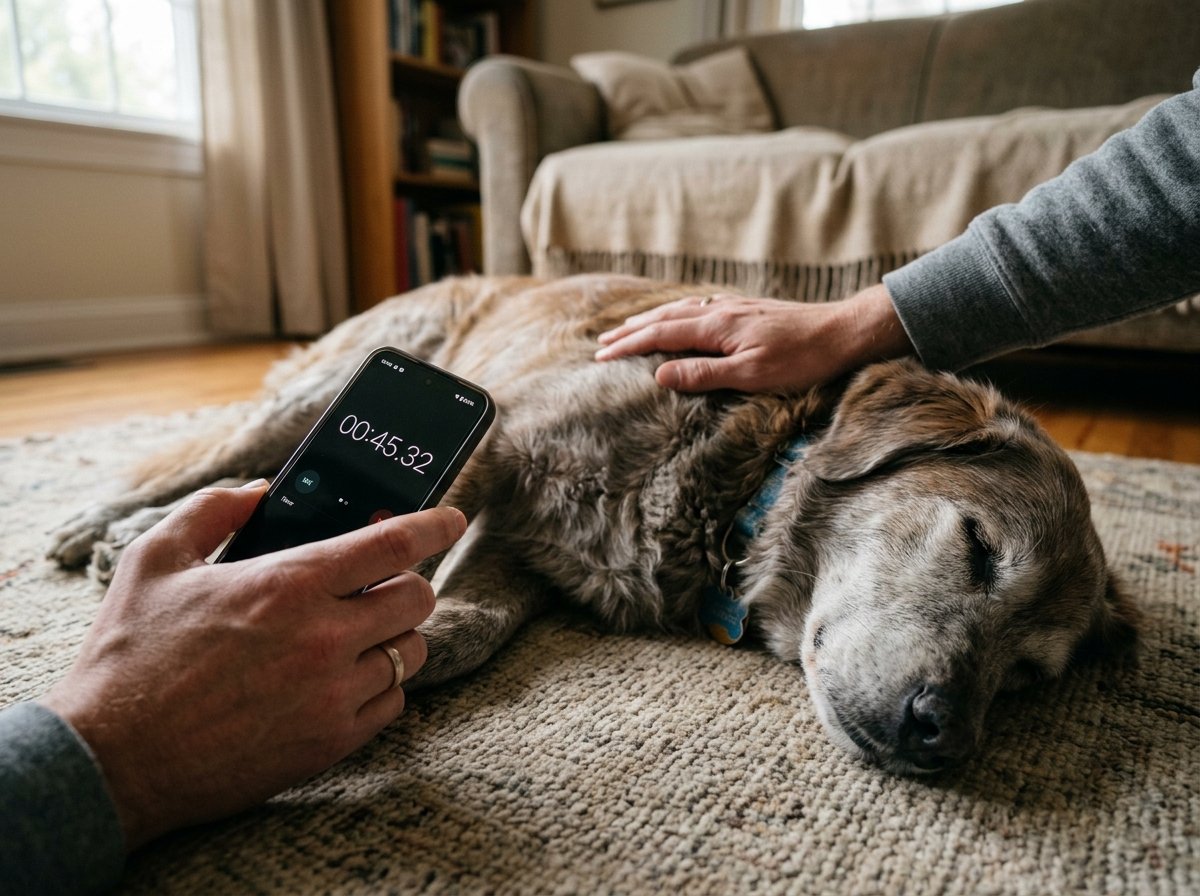
How to Track Sleeping Respiratory Rate (SRR) at Home
Tracking your dog’s Sleeping Respiratory Rate (SRR) is the single most powerful home health tool for dogs diagnosed with a heart murmur.
Step-by-Step SRR Guide:
- Wait for Deep Sleep: Wait until your dog is lying down, fully relaxed, and in deep, quiet sleep (not dreaming, twitching, or panting from recent play).
- Watch the Chest Movements: One breath equals one complete cycle: chest expansion (inhalation) plus chest fall (exhalation).
- Count for 30 Seconds: Count the number of breaths in 30 seconds, then multiply by 2 to get the total breaths per minute (bpm).
- Log Your Numbers: Record the daily number on your phone or a notebook.
- Normal & Safe: Under 30 breaths per minute (typically 15 to 25 bpm).
- Borderline Warning: 30 to 35 breaths per minute on consecutive days. Call your vet for an evaluation.
- Emergency Red Flag: Consistently over 35–40 breaths per minute while sleeping, or laboured belly breathing. Contact your emergency vet immediately.

When to Call Your Vet: Emergency Red Flags
While routine follow-ups keep murmurs stable, certain symptoms indicate that fluid has entered the lungs and requires urgent care.
| Symptom Combination | Required Action |
|---|---|
| New Grade 1–2 murmur + Zero coughing, active and happy | Routine baseline veterinary checkup & annual recheck |
| Grade 3+ murmur OR mild coughing after waking up | Schedule veterinary chest X-rays & echocardiogram |
| Sleeping breathing rate consistently over 35 bpm | Same-day veterinary evaluation (suspected pulmonary fluid) |
| Severe laboured breathing + Blue/grey gums + Collapse | Immediate emergency veterinary clinic visit (suspected acute CHF) |
Schedule a prompt veterinary exam if:
- Your dog develops a soft, dry hacking cough, especially at night or after waking.
- Your dog tires noticeably faster during normal neighborhood walks.
- You notice their sleeping breathing rate creeping from 18 bpm up to 28 bpm.
Seek immediate emergency care if:
- Your dog stands with elbows pointed outward and neck extended, struggling for air.
- Your dog coughs up pinkish or white frothy liquid.
- Your dog’s tongue or gums appear pale, grey, or bluish.
- Your dog suddenly collapses or faints (syncope) after excitement or barking.
According to veterinary cardiology standards published on PetMD’s guide on canine mitral valve disease, obtaining baseline chest radiographs is critical to measure the Vertebral Heart Score (VHS) and determine exact heart dimensions.
5 Safe Home Steps to Care for a Dog with a Heart Murmur
Alongside veterinary monitoring, these five gentle home practices keep your companion comfortable and protect heart health.
Step 1: Administer Prescribed Heart Medications Reliably
If your dog is staged at B2 or C and prescribed pimobendan (Vetmedin), give it exactly on time, ideally one hour before meals on an empty stomach for maximum absorption.
Never skip doses or alter diuretic amounts (like furosemide) without your veterinarian’s direct guidance, as balance between heart support and kidney hydration is delicate.
Step 2: Switch to Gentle, Consistent Leash Walking
Senior dogs with heart murmurs still need daily physical and mental exercise to maintain muscle tone and emotional joy.
Replace intense ball chasing or steep uphill hikes with flat, leisurely sniff walks. Keep walks to 15 or 20 minutes during cool mornings or evenings, and let your dog set the walking pace. Explore joint comfort in our guide on senior dog joint stiffness remedies.
Step 3: Feed a Moderate-Sodium, High-Quality Protein Diet
Avoid high-sodium commercial treats, hot dogs, cheese scraps, and processed meats, which cause fluid retention and increase blood pressure.
Feed a nutritionally balanced senior diet enriched with Omega-3 fatty acids (EPA/DHA), L-carnitine, and taurine to support cardiac muscle cells. For gentle nutrition, explore our guide on limited ingredient dog food for senior dogs.
Step 4: Protect Against Extreme Heat and Humidity
Hot, humid weather places intense strain on a compromised cardiovascular system, as dogs must pant heavily to cool down.
Keep your dog in an air-conditioned room during summer heat waves and avoid outdoor midday sun. For general home setups, review our guide on keeping senior dogs comfortable.
Step 5: Maintain Regular Veterinary Cardiac Checks
Schedule a follow-up stethoscope exam and blood pressure check every six months.
Tracking murmur progression and monitoring kidney values on bloodwork ensures medication dosages are adjusted before complications arise. For daily routine care, explore our guide on senior dog routine daily schedules.
What Not to Do When Your Dog Has a Heart Murmur
Avoid these common mistakes to protect your dog’s cardiovascular health:
- Never Force High-Intensity Exercise: If your dog sits down or pants heavily during a walk, stop immediately and rest. Never force an older dog with a murmur to keep walking.
- Never Give Salty Human Table Snacks: Processed meats, bacon, and chips deliver massive sodium loads that trigger fluid accumulation in the lungs.
- Never Ignore a Rising Sleeping Breath Rate: A rising respiratory rate while resting is the earliest warning sign of fluid in the lungs; catching it early prevents emergency hospitalization.
Frequently Asked Questions
Can a dog live a full life with a heart murmur?
Yes. Many dogs diagnosed with low-grade heart murmurs live full, happy lifespans without ever progressing into heart failure, especially when monitored and managed proactively.
What causes a heart murmur in an older dog?
In senior dogs, the most common cause is Myxomatous Mitral Valve Disease (MMVD), where the heart valves gradually thicken and allow blood to leak backward during pumping.
How do I know if my dog’s heart murmur is getting worse?
Signs of progression include a higher murmur grade, night-time coughing, exercise intolerance, and an elevated sleeping respiratory rate exceeding 30 breaths per minute.
What is the difference between a heart murmur and heart failure?
A heart murmur is the physical sound of turbulent blood flow across a leaky valve. Heart failure (CHF) occurs much later when the heart can no longer pump effectively, causing fluid to back up into the lungs.
Is pimobendan (Vetmedin) safe for older dogs?
Yes. Pimobendan is one of the safest and most effective canine cardiac medications available. It strengthens heart contractions and dilates blood vessels, significantly extending quality of life.
Guiding Your Senior Dog with Compassion and Care
Learning that your dog has a heart murmur is an invitation to provide thoughtful, proactive care. By monitoring their sleeping respiratory rate, offering gentle walks, and working closely with your veterinarian for timely staging, you help your loyal companion enjoy a comfortable, joyful life.
Always collaborate with your veterinarian for diagnostic X-rays and tailored medication plans. Review official resources from the American Veterinary Medical Association senior pet care FAQ to keep your companion thriving throughout their golden years.