

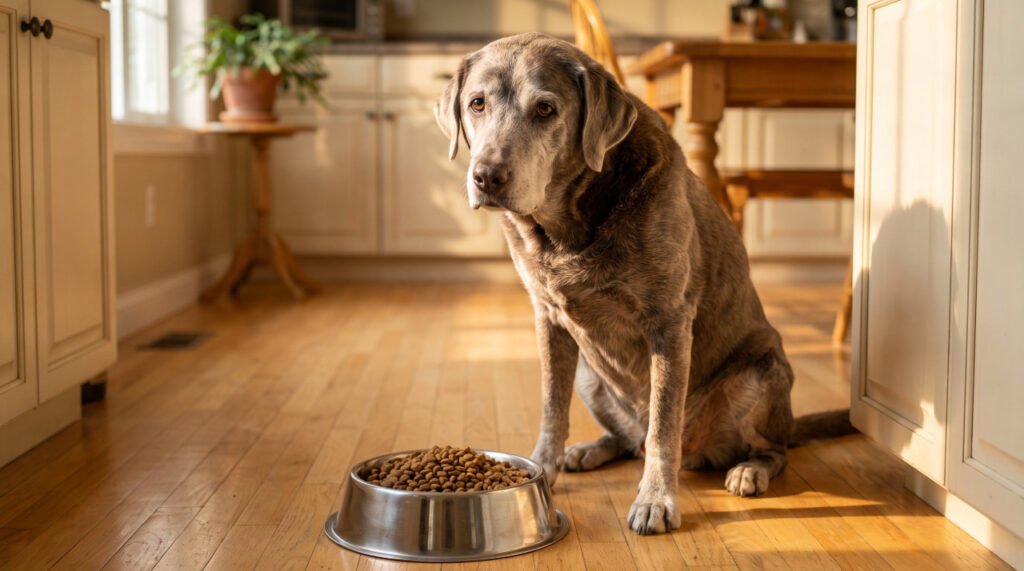
Most kibble bags give feeding amounts for adult dogs — not seniors. If you’ve been trusting that label, you may have been feeding your older dog the wrong amount for years.
That’s not your fault. It’s one of the most common mistakes senior dog owners make, and it’s almost built into the system. Your dog’s body has changed significantly since those adult-formula guidelines were written. Their metabolism has slowed, their muscle mass has shifted, and their calorie needs are genuinely different now.
This guide gives you what you’re actually looking for: specific feeding amounts based on your dog’s weight, a simple calorie formula you can run at home, and clear warning signs that your current portions are off. By the time you finish reading, you’ll know how much to feed your senior dog with real confidence — not guesswork.
When Does a Dog Become a “Senior”?
The answer depends on breed size, not age alone. According to the American Veterinary Medical Association’s senior pet guidelines, dogs are generally classified as senior at these life stages:
- Small breeds (under 20 lbs): Senior at 10–12 years
- Medium breeds (20–50 lbs): Senior at 8–10 years
- Large breeds (50–90 lbs): Senior at 7–8 years
- Giant breeds (90+ lbs): Senior as early as 5–6 years
This matters because a 7-year-old Chihuahua is still in middle age, while a 7-year-old Great Dane is genuinely elderly. Your feeding strategy should reflect that difference.
Why Your Dog’s Food Needs Change With Age
Senior dogs burn fewer calories at rest than they did at peak adulthood. Their thyroid function often slows, lean muscle mass decreases (a process called sarcopenia), and many develop arthritis that reduces how much they move.
The result: the same food amount that kept your dog lean at age 4 may now cause weight gain at age 9. On average, senior dogs need 20–30% fewer calories than they did during their adult years, according to research published by the National Research Council on nutrient requirements for dogs.
There’s an important exception, though. Some seniors — especially very old dogs or those with an illness — lose weight rather than gain it. If your dog is dropping weight despite eating well, that’s a different problem entirely. You can read more about that in our guide to how to help a senior dog gain weight.
How Much Should I Feed My Senior Dog? The Calorie Method
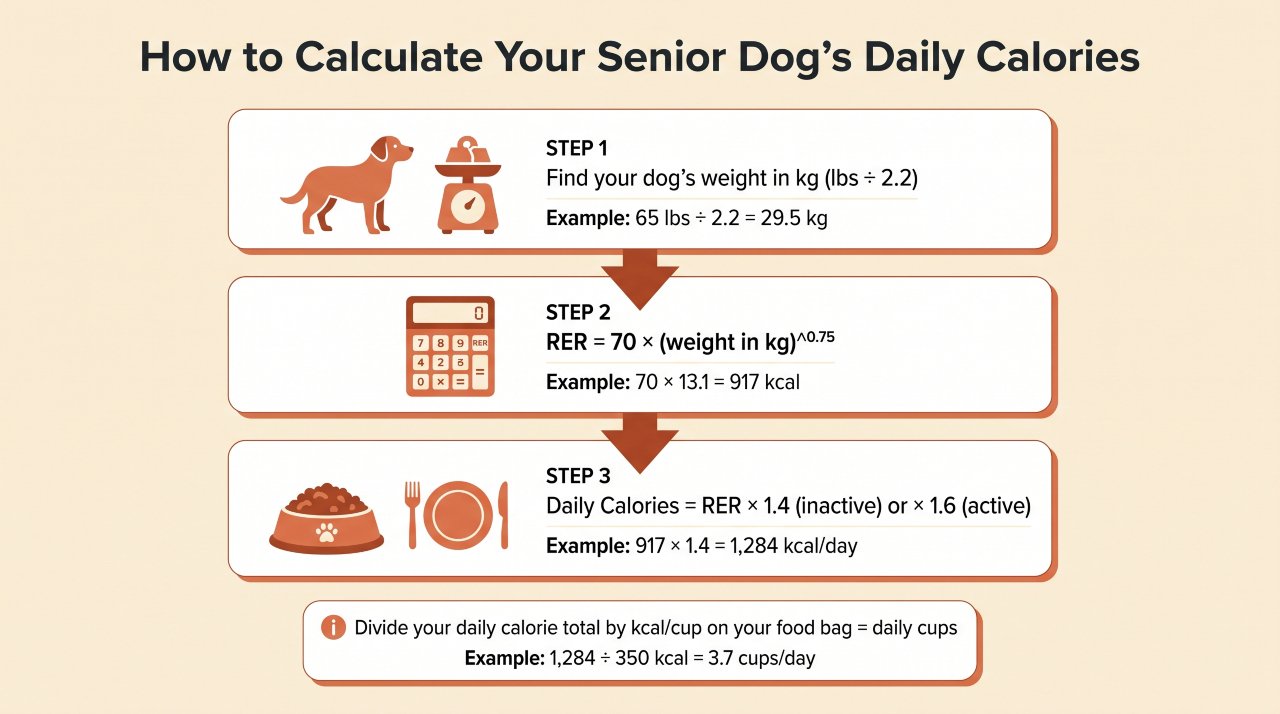
The most accurate way to find your senior dog’s daily food amount isn’t the bag label — it’s a two-step calorie formula vets use every day.
Step 1: Calculate Resting Energy Requirement (RER)
RER = 70 × (body weight in kg)^0.75
To convert your dog’s weight to kilograms, divide pounds by 2.2.
Step 2: Apply the Senior Multiplier
Multiply the RER by a life-stage factor. For senior dogs, the standard factor is 1.4 for a typical inactive senior and 1.6 for a moderately active one.
Daily calorie need = RER × 1.4 (or 1.6)
Example: A 10-year-old Labrador weighing 65 lbs (29.5 kg)
- RER = 70 × (29.5)^0.75 = 70 × 13.1 = 917 calories
- Daily need (inactive senior) = 917 × 1.4 = ~1,284 calories per day
Now check your dog food’s calorie content (listed as kcal/cup on the bag or manufacturer website) and divide.
If your food has 350 kcal/cup: 1,284 ÷ 350 = ~3.7 cups per day
This is dramatically more useful than any generic bag label. For help figuring out what type of food fits those calories best, check out our guide to what to feed an elderly dog.
Senior Dog Feeding Chart by Weight
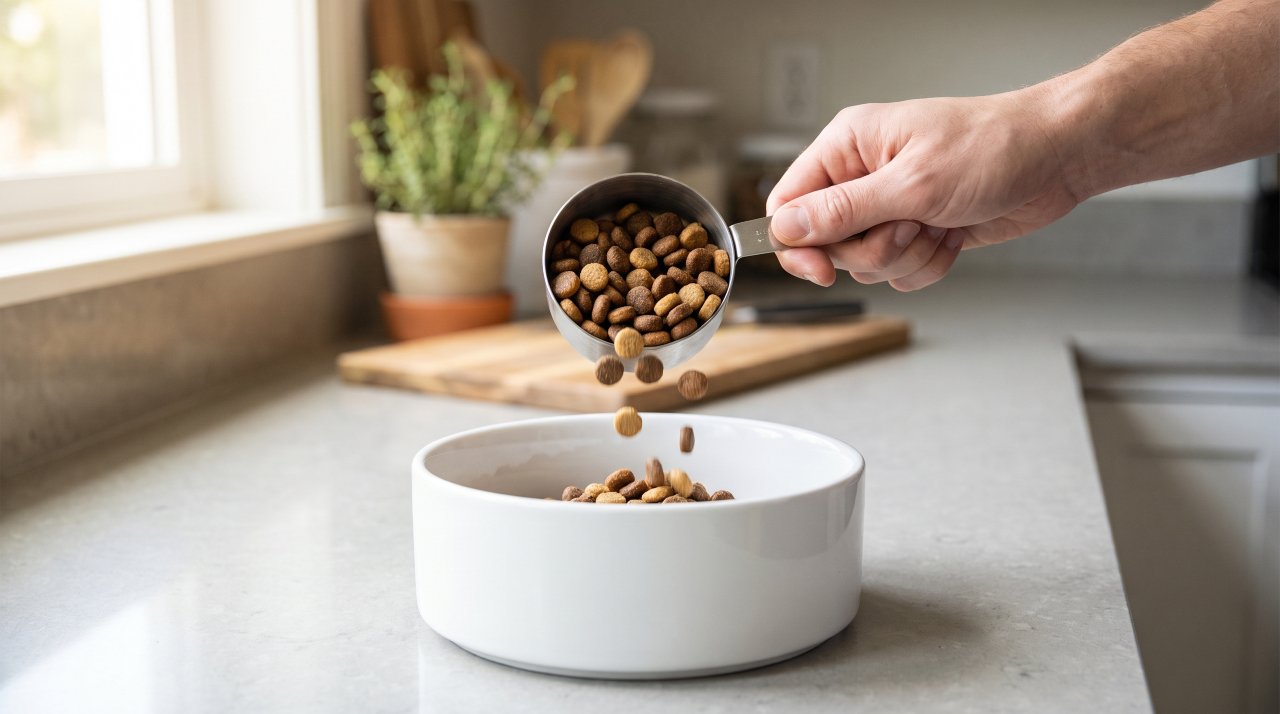
Use this chart as a starting point only — individual dogs vary based on health, activity, and food type. These estimates assume a standard dry kibble at approximately 350–380 kcal/cup.
| Dog’s Weight | Approx. Daily Calories (Senior) | Approx. Daily Kibble |
|---|---|---|
| 10 lbs (4.5 kg) | 210–270 kcal | ½ – ¾ cup |
| 20 lbs (9 kg) | 350–440 kcal | 1 – 1¼ cups |
| 30 lbs (13.6 kg) | 470–590 kcal | 1¼ – 1¾ cups |
| 40 lbs (18 kg) | 580–730 kcal | 1½ – 2 cups |
| 50 lbs (22.7 kg) | 690–870 kcal | 2 – 2½ cups |
| 65 lbs (29.5 kg) | 860–1,100 kcal | 2½ – 3 cups |
| 80 lbs (36.3 kg) | 1,020–1,280 kcal | 3 – 3¾ cups |
| 100 lbs (45.4 kg) | 1,220–1,530 kcal | 3½ – 4½ cups |
Note: Wet food has far fewer calories per volume. A standard 13 oz can typically contains 350–450 kcal total. If you feed wet food, you’ll need 2–4 cans per day for a medium to large senior dog.
How Often Should You Feed a Senior Dog Per Day?
Most adult dogs eat twice a day, and that generally works well for seniors too. Two meals — morning and evening — helps maintain stable blood sugar, reduces hunger-driven begging, and makes it easier for you to monitor how much your dog actually eats.
Some vets recommend three smaller meals for seniors with digestive sensitivities, acid reflux, or very low body weight. More frequent, smaller portions are gentler on an aging gut and can help dogs who seem to lose interest mid-meal.
One meal a day is not recommended for senior dogs. Their digestive systems work more slowly, and a single large meal increases the risk of bloat (gastric dilatation-volvulus), especially in deep-chested breeds like German Shepherds, Dobermans, and Great Danes.
The Body Condition Score: Your Best Ongoing Tool
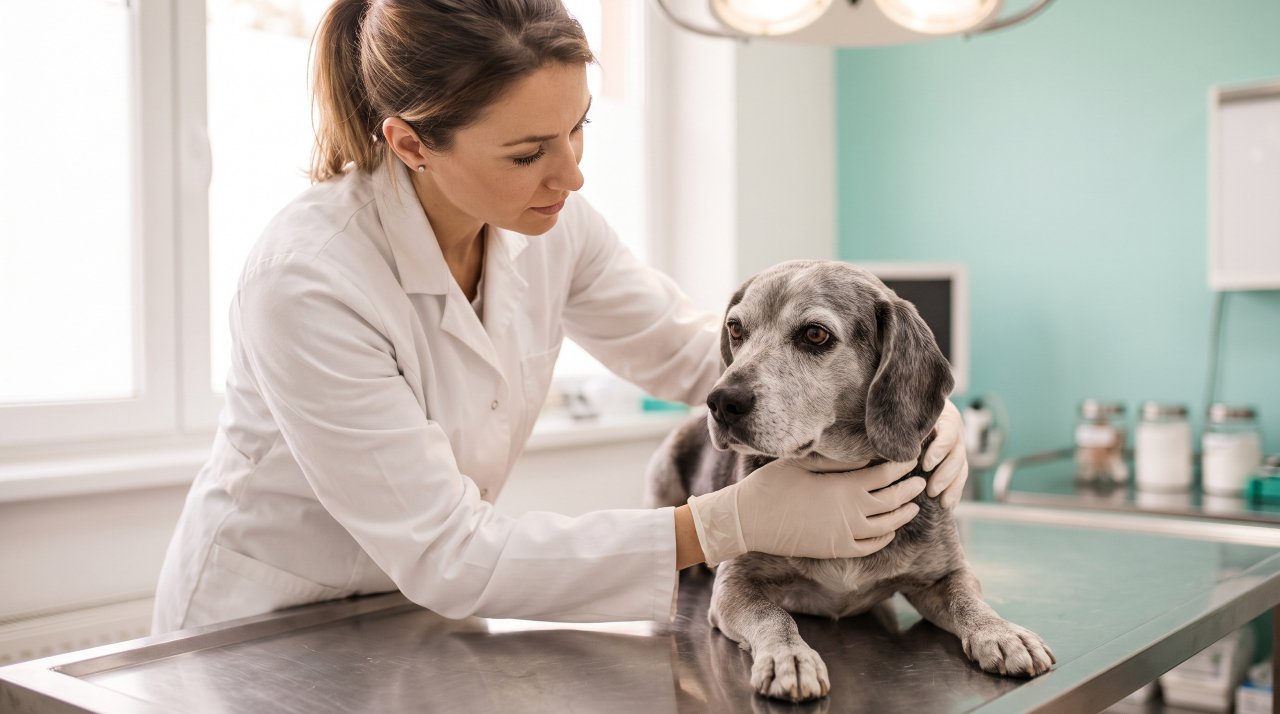
Calorie math gives you a starting point. But the Body Condition Score (BCS) tells you whether that starting point is actually working.
The BCS is a 9-point scale used by vets worldwide. You assess your dog by sight and touch — no scale needed. According to the World Small Animal Veterinary Association’s BCS guidelines:
- BCS 1–3: Underweight. Ribs, spine, and hip bones are visibly prominent. You need to increase food.
- BCS 4–5: Ideal weight. Ribs felt easily but not seen. Waist visible from above. Slight abdominal tuck from the side.
- BCS 6–7: Overweight. Ribs are hard to feel under fat. No visible waist. You need to reduce food.
- BCS 8–9: Obese. Large fat deposits, no waist, distended abdomen. Vet visit needed.
Check your dog’s BCS every 2–4 weeks. Adjust food by 10% increments — not dramatic cuts or additions. Small changes let your dog’s body adapt and let you accurately see what’s working.
Signs You’re Feeding Too Much or Too Little
Your dog can’t tell you when portions feel wrong. These physical and behavioral signals can.
Signs you may be overfeeding:
- Visible weight gain over 4–6 weeks
- Ribs are difficult or impossible to feel
- Your dog seems sluggish or reluctant to move
- Loose stools or frequent gas
Signs you may be underfeeding:
- Ribs and spine are prominently visible
- Your dog finishes meals in under 30 seconds and searches for more
- Weight loss you haven’t intentionally caused
- Dull coat, low energy, or muscle wasting along the back and hindquarters
If your dog is eating normally but losing weight anyway, that’s worth a vet call quickly. Unexplained weight loss in older dogs can signal thyroid disease, diabetes, kidney disease, or cancer.
For dogs who seem uninterested in food altogether, our guide on what to feed an old dog that won’t eat covers the most effective fixes.
A Note on Protein: Don’t Cut It
One of the most common misconceptions about senior dog feeding is that older dogs need less protein. This idea comes from outdated thinking about kidney disease — the logic being that high protein strains the kidneys.
Current research has reversed this view. A 2019 study published in the Journal of Veterinary Internal Medicine found that healthy senior dogs actually need more protein, not less, to maintain muscle mass as they age. Protein restriction is only appropriate in dogs already diagnosed with advanced kidney disease, and even then, only under direct veterinary guidance.
If you’ve been feeding your senior dog a low-protein formula based on that old advice, it may be worth re-evaluating with your vet. For a full breakdown of what nutrients aging dogs actually need, read our article on senior dog diet essentials.
What About Treats and Toppers?
Treats count as calories. This is the part most owners forget — and it genuinely matters.
If your senior dog gets 20% of their daily calories from treats, you need to reduce their meal portions by roughly the same amount. A single dental chew can contain 70–100 calories. For a small senior dog with a 300-calorie daily budget, that one chew represents nearly a third of their daily intake.
Apply the “10% rule” for treats: treats should make up no more than 10% of your dog’s total daily calories. Count them, adjust meals accordingly, and you’ll maintain much better weight control.
Honest Limitations of This Guide
This article gives you the best starting framework available without a vet exam. But every dog is different, and some seniors have conditions that change the rules significantly.
Dogs with kidney disease, liver disease, diabetes, pancreatitis, or cancer often need very specific dietary adjustments that go beyond standard calorie math. If your dog has any diagnosed condition, work directly with your vet or a board-certified veterinary nutritionist before applying these formulas.
Similarly, the calorie chart above assumes a healthy senior at maintenance weight. If your dog is significantly overweight or underweight, calorie targets need to be adjusted under professional guidance to avoid too-rapid weight change, which carries its own health risks.
FAQ: Senior Dog Feeding Questions
How many times a day should I feed my senior dog?
Feed your senior dog twice a day in most cases — once in the morning and once in the evening. If your dog has digestive issues, acid reflux, or very low body weight, three smaller meals spread through the day works better. Avoid one large daily meal, which increases bloat risk in seniors.
How do I know if I’m feeding my senior dog enough?
Use the Body Condition Score (BCS). At a healthy weight, you should feel your dog’s ribs easily without pressing hard, but not see them visibly protruding. A visible waist from above and a slight abdominal tuck from the side are both good signs. Check every 2–4 weeks and adjust by 10% if needed.
Should senior dogs eat less than adult dogs?
Most senior dogs need 20–30% fewer calories than they did during peak adulthood because their metabolism slows and activity decreases. The exception is very old or ill dogs who may struggle to maintain weight and actually need more calories or higher caloric density food.
How much wet food should I feed my senior dog per day?
A standard 13 oz can of wet dog food contains roughly 350–450 kcal. A 30-pound senior dog needs approximately 470–590 calories per day, so roughly 1 to 1.5 cans daily. Always check the specific kcal count on your brand’s packaging, as caloric density varies significantly between products.
Do senior dogs need less protein?
No — healthy senior dogs generally need the same or even slightly more protein than adult dogs to preserve muscle mass. Protein restriction is only appropriate for dogs with advanced, diagnosed kidney disease, and only under veterinary supervision. Don’t cut protein based on age alone.
What is a good feeding schedule for a senior dog?
A good schedule for most seniors is 7–8 AM and 5–6 PM. Consistent timing helps regulate digestion and keeps your dog’s appetite predictable. If you notice your dog seems very hungry mid-day or has digestive upset, splitting into three smaller meals — morning, midday, and early evening — is a reasonable adjustment.
You’re Doing Better Than You Think
Here’s the most important takeaway: the fact that you’re asking “how much should I feed my senior dog” means you’re already paying attention. Most feeding problems in senior dogs come from owners who never question the bag label. You’ve already cleared that hurdle.
Start with the calorie formula or the weight chart above. Check your dog’s Body Condition Score every few weeks. Adjust by 10% when something looks off. And book a vet visit if your dog is losing weight without an obvious reason, or if they’re significantly overweight.
Your next step is concrete: weigh your dog this week, calculate their RER using the formula above, and check the kcal/cup on their current food bag. That single calculation will tell you more than months of guessing from a generic label ever could.
For a complete look at what types of food work best for aging dogs alongside these amounts, read our full guide to the best diet for older dogs.