
Watching your graying companion hesitate at the end of the driveway, lag behind on their leash, or struggle with stiff limbs the morning after a regular neighborhood stroll is a sobering moment. The dog who once bounded ahead with joyful energy now walks with deliberate, careful steps. It is natural to wonder if walking is doing more harm than good, and many loving owners react by cutting out walks entirely.
Stopping physical exercise is one of the most damaging decisions you can make for an aging canine. Inactivity starts a vicious cycle: unused muscles wither, joint capsules tighten, cartilage dries out, and weight gain puts crushing pressure on fragile hips and knees. Canine joints require gentle, consistent motion to circulate lubricating synovial fluid and nourish cartilage cells.
The secret lies in adapting your expectations and implementing thoughtful, low-impact senior dog walking tips. When you trade fast-paced cardio for slow-paced sniffaris, softer walking surfaces, and structured warm-up routines, you protect your dog’s arthritic joints while preserving the mental joy and sensory fulfillment that make their golden years vibrant.
Quick Answer:
Safe walking for an arthritic senior dog requires shifting to low-impact micro-walks of ten to fifteen minutes, two to three times daily, rather than a single exhausting trek. Walk on natural forgiving surfaces like grass or packed dirt trails, use a padded Y-shaped chest harness instead of a neck collar, warm up stiff hips with gentle massage before leaving home, and let your dog dictate the pace with plenty of olfactory sniffing stops.
Key Takeaways:
- Movement as Medicine: Controlled low-impact walking circulates joint-lubricating synovial fluid and prevents disuse sarcopenia.
- Surface Selection: Hard asphalt and concrete transmit concussive shock straight into arthritic joints; prioritize natural grass and packed dirt.
- The Sniffari Shift: Allowing your dog to sniff freely provides profound mental stimulation without requiring exhausting physical mileage.
- The Morning-After Test: Evaluate your walk’s appropriateness by observing how comfortably your dog rises the following morning.
- Proper Gear: Eliminate throat strain by replacing traditional collars with supportive chest harnesses or dual-handle mobility vests.
Why Low-Impact Movement Matters for Aging Joints
To exercise an arthritic canine safely, you must understand how movement impacts joint biology. Cartilage has no direct blood supply. It relies entirely on a physiological process called passive diffusion to absorb oxygen and nutrients. Every time your dog bears weight and flexes a joint, fluid squeezes out of the cartilage matrix; when weight is lifted, fresh, nutrient-rich synovial fluid is absorbed back in.
When an older dog remains sedentary on a bed for days, this biological sponge mechanism halts. Cartilage cells starve, waste products accumulate, and the surrounding joint capsule becomes thick and fibrous. The result is the classic morning stiffness where every initial step looks agonizing.
Muscle mass is the primary shock absorber for the canine skeleton. Strong quadriceps, hamstrings, and shoulder muscles absorb kinetic impact before that force reaches degenerated bones. When dogs stop walking, age-related sarcopenia accelerates. Withered muscles transfer all walking stress directly onto bone spurs and inflamed cartilage.
According to veterinary guidelines from the American Kennel Club senior dog exercise recommendations, low-impact exercise maintains vital muscle tone without triggering the destructive inflammatory cascades caused by high-intensity running or jumping.
Gentle walking also combats obesity. Extra body weight acts like a mechanical multiplier on arthritic limbs. Shedding just five to eight percent of excess body weight dramatically reduces joint pain and often restores rising ease without increasing medication doses.
The Sniffari: Redefining the Purpose of a Walk
Human dog owners often judge a walk’s success by miles covered, calories burned, or time spent in brisk motion. For a senior dog, this human metric is completely counterproductive. An older canine does not care about your fitness tracker; they care about experiencing their neighborhood.
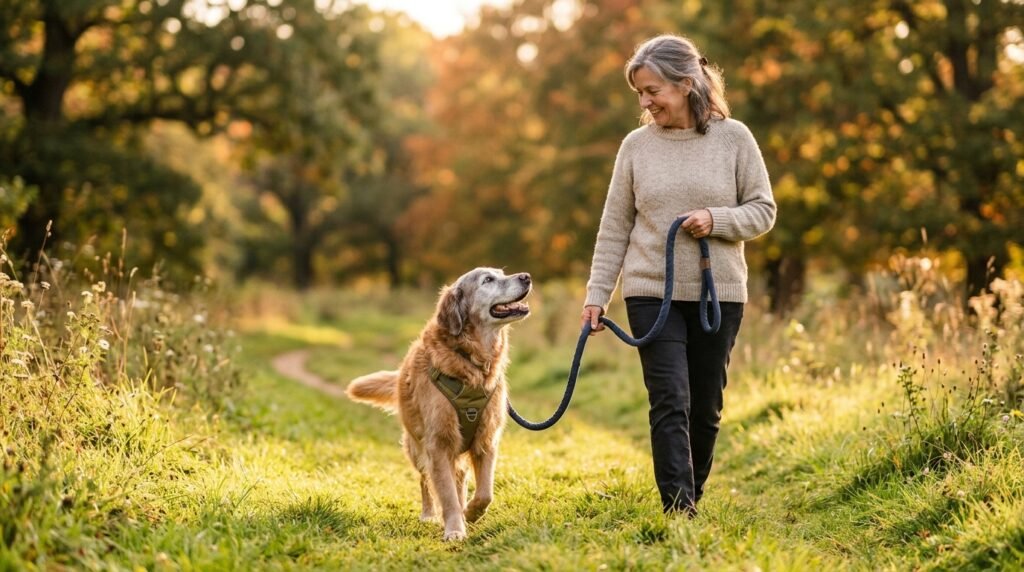
Transforming your daily routine into a dedicated sniffari is one of the greatest gifts you can offer an aging companion. A sniffari is a walk where your dog dictates the speed, path, and duration, spending as much time as they desire sniffing mailboxes, tree bark, grass tufts, and fire hydrants.
A canine’s sense of smell is forty times more sensitive than ours, and their olfactory processing center occupies a substantial portion of their brain. Processing complex scent layers is an intensive mental workout that releases dopamine, triggers endorphin production, and lowers systemic cortisol. Fifteen minutes of deep sniffing leaves an older dog as content and relaxed as an hour of strenuous hiking.
Because sniffaris involve frequent pauses and slow walking speeds, your dog’s joints never face sustained, repetitive pounding. They can investigate a fascinating scent for three minutes, allowing their hip muscles to rest, before ambling five yards to the next sensory landmark.
Walking Surfaces: Hard Pavement vs Soft Terrain
The ground beneath your dog’s paws plays a massive role in their post-walk comfort. Walking on hard, unyielding surfaces like asphalt, concrete sidewalks, and packed cobblestones sends jarring concussive shockwaves upward through the paws into arthritic wrists, elbows, stifles, and hips.
Whenever possible, seek out forgiving, natural surfaces that absorb kinetic impact. Even moving from the center of a paved sidewalk onto the adjacent grass parkway reduces joint impact significantly.
| Walking Surface | Impact on Joints | Traction Level | Best Practices & Precautions |
|---|---|---|---|
| Concrete & Asphalt | Severe concussive shock | Moderate grip; abrasive | Limit exposure; wears down scuffing claws rapidly; heats up in sun |
| Lawn Grass & Parks | Very low impact; cushioned | Excellent natural friction | Well suited for daily strolls; watch for hidden gopher holes and divots |
| Packed Dirt Trails | Low impact; natural cushion | High dependable grip | Wonderful for nature strolls; avoid steep grades and exposed tree roots |
| Fine Wood Mulch | Extremely soft cushioning | Moderate to shifting | Gentle on paws; avoid deep loose mulch that causes foot sinking |
| Deep Loose Sand | High resistance strain | Unstable; shifting | Avoid completely; acts like quicksand, straining weak cruciate ligaments |
Be vigilant about weather extremes. In hot summer weather, black asphalt absorbs solar radiation, reaching surface temperatures above one hundred and thirty degrees. Because older dogs cannot regulate their body heat efficiently, walking on hot pavement invites burned paw pads and rapid heat exhaustion. In winter, freezing temperatures stiffen arthritic joints, while hidden patches of black ice can cause sudden slips that tear delicate hip ligaments.
Warm-Up and Cool-Down Routines
Human athletes would never dream of springing from a deep sleep straight into a brisk jog without warming up their muscles. Yet many dog owners clip on a leash and head straight out the front door within thirty seconds of their dog waking up. For an arthritic canine, stepping onto cold sidewalks with cold joints is an invitation to pain.
Implement a brief five-minute indoor warm-up routine before clipping on the leash. While your companion is resting on their rug, apply a warm towel or fleece-wrapped heating pack to their hips, knees, and lower spine for five minutes. Warmth increases local circulation, boosts tissue flexibility, and relieves joint stiffness.
Follow the heat with gentle passive range of motion (PROM) stretches. Support their rear leg at the stifle and hock, and gently bicycle the limb forward and back through comfortable ranges of motion. Ten gentle repetitions per leg circulate synovial fluid before they bear their full body weight.
When you return from your walk, incorporate a brief cool-down. Gently wipe their paws with a warm, damp cloth to remove grit, salt, or mud that could cause licking. Offer fresh cool water, and guide them to a supportive bed. Review our recommendations in the best orthopedic beds for senior dogs guide to ensure their post-walk rest allows muscles to relax without painful pressure points.
Essential Walking Gear for Arthritic Dogs
Using the wrong equipment turns a peaceful stroll into a physically jarring experience. Standard flat neck collars should never be used for walking an older dog. Any sudden pull or stumble transmits tension straight to the cervical vertebrae, aggravating disc disease and triggering nerve pinches.
Upgrade to a well-fitted, padded Y-shaped chest harness. A Y-shaped harness rests across the sternum and chest, distributing pulling forces across the broad ribcage while leaving the shoulders completely free to extend naturally. Harnesses with narrow horizontal chest straps that cut across the front of the shoulders restrict forward leg movement and exacerbate shoulder arthritis.
For dogs that need physical support on curbs or steps, dual-handle rehabilitation harnesses are invaluable. Having a sturdy handle above the hips allows you to take twenty percent of their weight off their back legs when stepping off sidewalks. To explore dedicated models, read our overview of mobility aids for senior dogs, including full-body support gear.
If your companion drags their rear toes, listen for the telltale scraping sound of claws on concrete. Toe dragging wears nails down to the sensitive blood quick, causing bleeding and infection. Protective rubberized booties or specialized toe-up slings lift the foot during the swing phase of walking, preventing abrasions.
Alternative Low-Impact Exercise Options
Walking around the neighborhood is not the only way to keep an older dog physically active. On rainy days, snowy afternoons, or days when joint stiffness is elevated, alternative low-impact exercises maintain mobility without pavement impact.
Canine hydrotherapy is the undisputed champion of low-impact physical conditioning. Certified rehabilitation facilities utilize heated underwater treadmills filled with water kept at eighty-eight to ninety-two degrees. As the water level rises to the dog’s chest, buoyancy absorbs over sixty percent of their body weight, allowing them to rebuild quadriceps and gluteal muscle mass with zero joint compression.
According to veterinary arthritis research from the Cornell University College of Veterinary Medicine osteoarthritis resources, controlled underwater exercise enhances joint flexion angles and slows progressive cartilage breakdown far more effectively than land exercise alone.
You can also create gentle indoor obstacle courses using cavaletti rails. Lay broomsticks, foam noodles, or rolled towels flat across a carpeted living room floor, spaced twelve inches apart. Walk your dog slowly over the obstacles on a loose leash. Stepping deliberately over low obstacles forces your dog to lift their paws, engaging core stabilizer muscles and improving nervous system proprioception.
Recognizing Signs of Exercise Exhaustion and Pain
Dogs are eager to please their human companions. Many loving dogs will push through excruciating pain just to stay beside you, giving no outward complaint until their legs completely give out. Learning to read subtle signs of exercise fatigue ensures you stop before damage occurs.
Watch for spatulate panting. In a comfortable dog, the tongue hangs loosely from the front of the mouth. In an exhausted dog experiencing pain, the tongue swells, widens into a spoon shape, and curls up at the edges. Heavy panting accompanied by glazed eyes means your dog has reached their physical limit.
Other unmistakable red flags include lagging behind on a loose leash, sitting down repeatedly on the sidewalk, bunny hopping with both rear legs moving together, or head bobbing. Head bobbing is a classic sign of limb lameness: a dog raises their head when the sore limb touches the ground to take weight off it, and lowers their head when stepping on the healthy limb.
If you observe these warning signs, stop the walk immediately. Rest in the shade, offer water, and assist your companion home using your support harness or a pet wagon. To learn how to spot other quiet signals, review our guide on subtle senior dog pain signs to identify discomfort before it escalates.
The Morning-After Test: Calibrating Walk Distance
How do you know if a twenty-minute walk was the right length? You evaluate your companion the next morning. The morning-after test is the most accurate metric for calibrating your dog’s exercise tolerance.
Observe your dog when they wake up tomorrow. If they rise with their usual baseline ease, stretch comfortably, and greet you at the kitchen door, yesterday’s walk was within their safe biological window. You can maintain that distance and duration with confidence.
However, if your companion struggles to stand, groans while rising, limps for more than ten minutes, or refuses their morning breakfast, yesterday’s walk exceeded their physical threshold. The excess exercise triggered joint inflammation that took hours to manifest.
When this happens, give your companion forty-eight hours of rest and gentle heat therapy. Once their baseline mobility returns, reduce the walk duration by thirty percent. Consistency is vastly more beneficial than peak mileage.
Veterinary Medical Pairing: Making Walks Comfortable
Exercise modifications work best when supported by modern veterinary pain management. You cannot exercise away unmanaged bone-on-bone friction. Medical pain relief and gentle movement must function as collaborative partners.
Consult your veterinarian to establish a structured multimodal pain protocol. Modern non-steroidal anti-inflammatory drugs (NSAIDs) such as Galliprant, carprofen, or meloxicam target inflammatory prostaglandins directly. Pairing NSAIDs with neuropathic pain modulators like gabapentin calms sensitized nerve pathways.
One of the most valuable advances in canine arthritis treatment is Librela (bedinvetmab). Librela is a monthly monoclonal antibody injection that binds to Canine Nerve Growth Factor (NGF), neutralizing joint pain signals before they reach the brain. Because it is metabolized naturally by the body like native proteins, it spares the liver and kidneys, allowing dogs who cannot take traditional NSAIDs to enjoy comfortable daily walks once again.
The American Animal Hospital Association pain management guidelines for dogs and cats emphasize that keeping senior pets active requires regular clinical monitoring and proactive medication adjustments as physical needs evolve.
Pairing veterinary pain relief with a calm household schedule keeps your dog comfortable around the clock. Explore our strategies for establishing a predictable senior dog daily routine to coordinate walking times, medication administration, and restorative sleep.
Frequently Asked Questions
How long should a senior dog with arthritis walk each day?
Most senior dogs with moderate arthritis thrive on two or three micro-walks of ten to fifteen minutes each, rather than one long outing. Breaking exercise into short sessions keeps joints warm and lubricated without triggering muscle exhaustion or joint inflammation.
Is it normal for an older dog to limp after a walk?
No. Limping after a walk indicates that the distance, speed, or terrain exceeded your dog’s joint tolerance and caused acute inflammation. Reduce the walk duration by half and consult your veterinarian to evaluate if their pain medication protocol needs adjustment.
Should I let my senior dog walk off-leash?
In most cases, keeping an older dog on a loose six-foot leash is much safer. Off-leash dogs may experience sudden bursts of adrenaline, chasing a squirrel or leaping over a ditch before their arthritic joints can handle the shock. A loose leash allows them to sniff freely while preventing sudden high-impact movements.
What should I do if my dog stops and refuses to walk further?
Never drag or force a reluctant senior dog forward. When an older dog stops and sits down, they are communicating acute pain or exhaustion. Let them rest in a shady spot for a few minutes. If they still cannot walk comfortably, use a support harness or carry them home, or call a family member to pick you up in the car.
Can walking in cold weather make canine arthritis worse?
Yes. Cold temperatures cause peripheral blood vessels to constrict, reducing blood flow to extremities and causing joint capsules to stiffen. Outfit your dog in a fleece-lined sweater or thermal jacket during winter walks, warm up their joints indoors beforehand, and keep cold-weather strolls brief.
Cherishing Every Step Together
Walking with an older dog requires letting go of past hurry and embracing the gentle pace of the present. While your companion may no longer sprint across fields, the quiet moments you share along the sidewalk are precious expressions of lifelong friendship.
By choosing soft ground, honoring their need to sniff, and supporting their body with thoughtful gear, you give your dog the freedom to experience the world without pain. Every wag of their tail, every satisfied sigh on their bed, and every steady step forward proves that life in the golden years remains deeply worth living.